Nyakagyezi, Uganda (CNN) -- Visiting his former village in rural Uganda, Jackson Kaguri was the epitome of a success story.
He had escaped poverty,
earned a college degree and moved to America, where he studied at an Ivy
League school and planned to put a down payment on a house in Indiana.
He'd often come back to Uganda, passing out school supplies to children.
But on one particular trip home in 2001, he realized he had to do more.
"We woke up in the
morning, and grandmothers had lined up all around the house, stretching
way back. ... The whole village had gathered," Kaguri said. "All these
women walked miles and miles. It was huge."
UNICEF estimates that 1.2
million children in Uganda have lost one or both parents to
AIDS-related illnesses, and Kaguri said it's often grandmothers who have
to pick up the slack.
"You see the grandmothers
over and over whose own children have died and left them," he said.
"Some of them have up to 14 (grandchildren) to raise in their homes.
Sometimes the child has HIV/AIDS, they need medication. The grandmother
needs food. They need a house. And nothing is there."
The grandmothers who
gathered in Kaguri's childhood village begged Kaguri to help them. And
he felt an obligation to give more than just pens, pencils and paper.
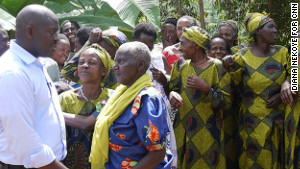
Grandmothers in Jackson Kaguri's former village urged him to do more to help. He didn't want to let them down.
"These are women who had
seen me grow up in the village," he said. "They carried me when I was
hurt, they prayed for me when I was away studying. What was I supposed
to do?"
Knowing that education
had been so key to his success, Kaguri and his wife decided to use their
life savings to start a free school in the village. They purchased two
acres of land and built the Nyaka School,
brick by brick, with the help of local volunteers. When the school
officially launched on January 2, 2003, 56 AIDS orphans were the first
students.
"We provide them
uniforms. We provide them pencils. We give them shoes," said Kaguri, 41.
"Everything we give ... is to try and eliminate as many obstacles as
possible, so children can be successful and focus on education."
Early on, it was noticed
that many children in the school were falling asleep because of hunger
and malnutrition. So the school began providing students two meals a
day. There is also a medical clinic on site.
Meanwhile, Kaguri
continued to raise money for the project while he worked full time in
the United States. When he learned that a child had walked more than 30
miles to attend the school, he started a second school, the Kutamba
School, in the village of Nyakishenyi.
Today, between the two
schools, there are 587 students -- kindergarten through 12th grade --
receiving a free education and health care. Nearly all of them have lost
either one or both parents to AIDS-related illnesses.
The issue hits
especially close to home for Kaguri, who has lost his brother, one of
his sisters and a 3-year-old nephew to the disease.
Kaguri says he felt
fortunate to have the financial means to help his brother's children
financially, but in many similar cases, children end up homeless.
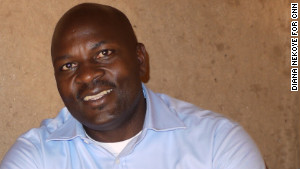
Kaguri, 41, runs his organization out of Michigan, but he travels to Uganda about three times a year.
"Many of them are on the
streets in Kampala eating from the dust bins," Kaguri said. "You see
all these street children because they have no one to help them."
It's these children Kaguri says he thinks about as he raises funds and awareness for his schools.
"(We) take care of
nearly 600 children in school," he said. "That leaves all these children
who are walking around without an opportunity to get an education, to
get health care, to get a meal to eat or even to get somebody to say, 'I
love you.' "
Of the students at his
schools, Kaguri estimates that 65% of them are being raised by their
grandmothers, many of whom are often without adequate health care,
finances or basic housing. So in 2008, he started a program that offers
support and education to the nearly 7,000 area grandmothers who are
raising their grandchildren.
The program teaches the
women practical life skills, offering advice on parenting, grief
management, basic medical care, gardening and business development.
Kaguri says that by
giving grandmothers access to microfunds, allowing them to start small
businesses and make money, more children have access to an education.
And by giving seeds to the grandmothers to grow, more children have
access to food.
Grandmothers "are the
pillars in the society, holding the society together," he said. "They
are unsung heroes that people don't recognize."
Every grandmother in the
program, Kaguri said, has received some form of training or household
equipment to improve their life. And his organization has also opened a
library, started a gardening program and installed a clean-water system
to benefit the entire village.
Kaguri, whose
organization is based in Michigan and is funded by individual donations
and private foundations, spends much of his time fundraising, speaking
and raising awareness. He travels to Uganda about three times a year.
He hopes this younger
generation will lift the country out of poverty and create a better
future for their families and communities. He says he dreams about
building a school in every district in Uganda.
"I want to be an uncle
for many so we can create other children who would be successful and do
great things," he said. "It's giving them a hand up, just holding
somebody's hand, trying to get (them) out of the pigeonhole they are in.
...
"I feel humbled looking in the faces of the children smiling, focused on what their dreams are going to be."
Want to get involved? Check out the Nyaka AIDS Orphans Project website at www.nyakaschool.org and see how to help.

No comments:
Post a Comment