Lake Mary, Florida (CNN) -- Shortly after joining the Lake Mary Police Department in 2007, Zach Hudson was dispatched to the home of two elderly women.
What he saw left him appalled.
The two women -- a mother
in her 90s and a daughter in her 70s -- had no food and no electricity.
Each month, they alternated what they spent their small amount of money
on: One month it would be medicine, the next it would be food and
bills.
"They were struggling
horrifically," Hudson recalled. "They had to cut their medications. They
were doing the things that seniors often do to try to make up the
financial difference."
In his 10 years as a
Florida police officer, Hudson had witnessed countless senior citizens
in tragic circumstances. But this was the last straw for him.
"I'd had enough," he
said. "And I realized that something had to be done. And that's when I
started to conceptualize the Seniors Intervention Group."
Since 2009, Hudson's
group has tended to the basic needs of nearly 1,000 seniors in Seminole
County, Florida. With the help of hundreds of local volunteers, seniors
are provided with essential assistance such as food, money,
transportation, vehicle maintenance and help around the house.
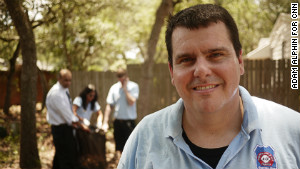
Zach Hudson was raised in a senior community by his grandparents and great-grandmother.
"If you're 80 years old
and you have to get up on a footstool to change your light bulb and you
fall, it could kill you," said Hudson, 40. "When it's 100 degrees
outside and you're faced with either doing your yard or being fined, and
you can't pay somebody to do it, what do you do? Well, you get out
there and do it and suck it up, right?
"But sucking it up killed
this (one) gentleman. A very kind elderly man walked outside to do his
yard, and he didn't survive. And that's happening all the time."
Hudson said seniors
facing diminished income in a difficult economy often have to make
life-and-death choices for where and how to spend their money. For
example, a light bulb that illuminates a doorway -- or a repair to a
front door -- might easily fall below food and medicine on a senior's
list of priorities and make them more vulnerable to crime.
If a licensed worker is
out of a senior's financial reach, they might be willing to pay cash to a
stranger who knocks on their door offering to clean their yard or
perform basic services. Too often, Hudson says, these strangers are not
who they say they are.
"As cops and
firefighters, we see people at their worst. That's just the way it is,"
Hudson said. "And when you see seniors on a regular basis ... and
they're constantly being scammed or victimized ... you start to ask
yourself: 'Why? What can we do? I'm tired of walking away from this
elderly person's house every day and not being able to fix the problem.'
...
"If you have a crime,
then (police) can handle it. If you have a fire, the fire department can
handle it. But what do you do when somebody can't pay their electric
bill and, as a result, that won't run their oxygen pump? How do you deal
with that?"
They're constantly being scammed or victimized ... you start to ask yourself: 'Why? What can we do?'
CNN Hero Zach Hudson
CNN Hero Zach Hudson
Forming the Seniors Intervention Group
was a natural offshoot of Hudson's job as community relations officer
for his department. The group became a nonprofit in early 2010, and it
expanded to include the entire county this year.
By partnering with
faith-based organizations, local businesses and other nonprofits, the
group can call upon hundreds of volunteers to make house calls. Seniors
are either referred by local first responders or reach out for help
directly. Assistance could be as minor as retrieving a pill that has
fallen behind a piece of heavy furniture or as major as rebuilding a
senior's home. All of the group's services are free and covered by
private donations.
About once every month,
the group schedules a large "operation" in which dozens of volunteers
descend upon a local neighborhood to do massive group service, such as
yard cleanup or a sweeping installation of energy-efficient lighting.
Hudson says this is often a great way to identify individuals who need
more help.
"That operation ...
always leads to finding other things, whether it's floor issues, window
issues, (air conditioning) issues, whatever the case might be," he said.
"It's a neat opportunity for us to get on the ground, take a good look
around and see how else we can help."
Hudson's dedication to
public safety might not be unique among police officers, but his
compassion for seniors is rooted in a more intimate history. He was
raised primarily by his grandparents and great-grandmother in a senior
community.
"Elderly people rescued
me in a lot of ways," he said. "They taught me respect. They taught me
so many things. And this is simply an opportunity for me to give back to
them in their time of need, because that time is here and it's now."
And it's something that
is only going to get worse over the next 20 years, according to the Pew
Research Center. Each day in the United States, about 10,000 Americans
turn 65. By 2030, when all baby boomers will have passed the milestone,
18% of the nation's population will be at least that age, Pew projects.
"We need more
organizations, more businesses, more churches, more police departments,
more fire departments to get on board, see the big picture, see the
problem," said Hudson, who hopes to see his nonprofit model replicated
nationwide. "This is just the beginning."
For seniors like Ralph Anderson, the group's efforts have been life-changing.
The Vietnam veteran had
worn a hole in his bathroom floor with his wheelchair, leaving him
vulnerable to an accident. It was also difficult for Anderson to leave
his home, so he had to often rely on other people to walk his dogs.
But he was introduced to
Hudson's group last month, and volunteers have since replaced and tiled
his bathroom floor, fixed his leaky kitchen faucet and installed a
wheelchair ramp at the front entrance of his home.
"It means the difference
between feeling like I'm a burden on someone and being able to do
something for myself," Anderson said. "Since they're putting this little
ramp (in), I can take the dogs out to walk them. I don't have to wait
for someone to come help me."
Hudson says that helping Anderson and other seniors is a pleasure and a privilege.
"(This) is an
opportunity for me to embrace the very people that embraced me growing
up. ... This is my chance to take care of them as they have taken care
of me."
Want to get involved? Check out the Seniors Intervention Group website at seniorsinterventiongroup.org and see how to help.

No comments:
Post a Comment